Sarva Pindi (Ginnappa): Warangal's Signature Snack, Explained
- 4 min read
- Food
Sarva pindi — ginnappa to Warangal locals — is the district's signature snack. Our guide explains the crisp rice-flour classic and where to find the real thing.
Best In Warangal — your local guide to food, culture and the city we call home.
Sarva pindi — ginnappa to Warangal locals — is the district's signature snack. Our guide explains the crisp rice-flour classic and where to find the real thing.
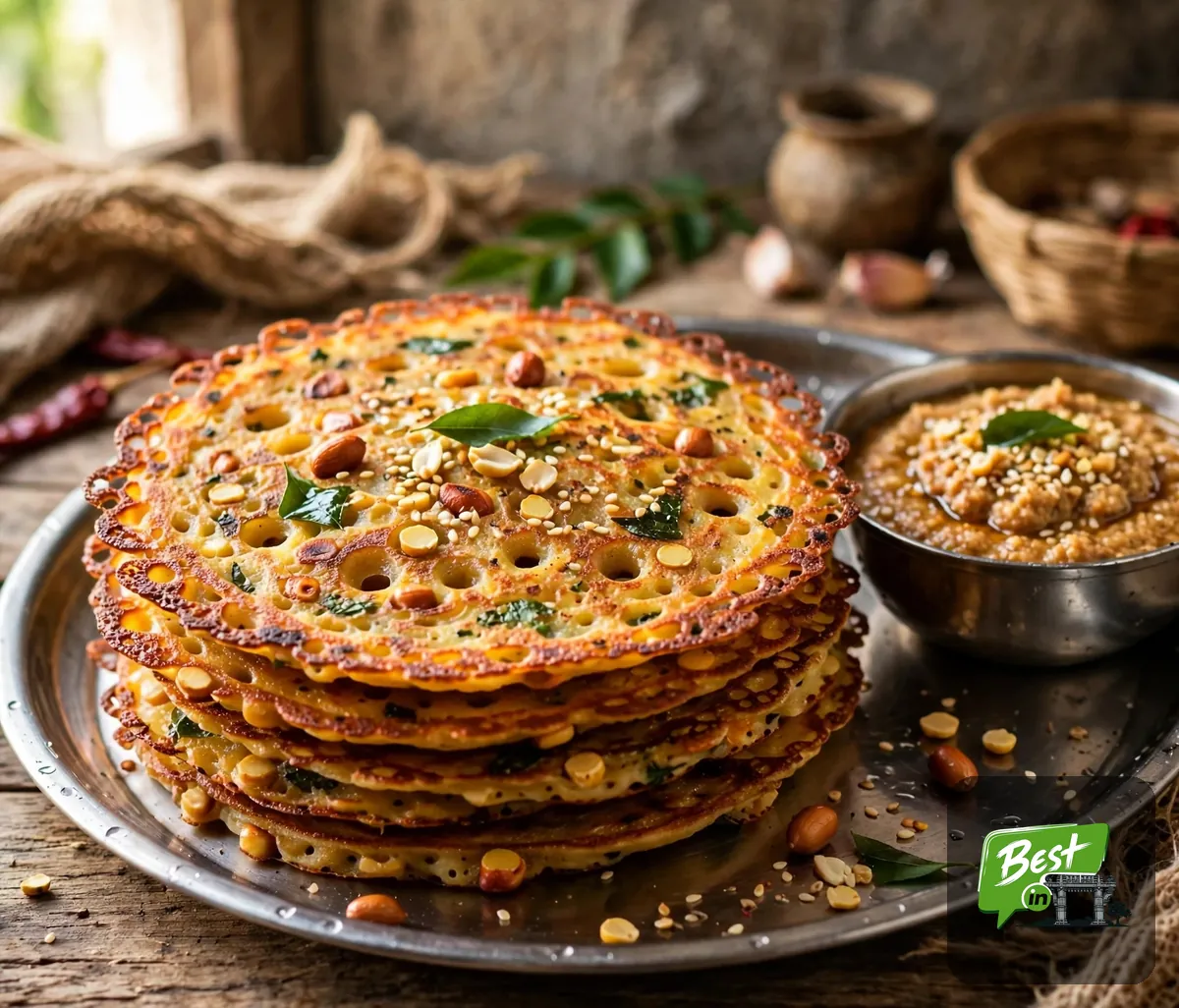
Every region of Telangana has a snack it claims as its own, and the Warangal district's claim is one of the strongest: sarva pindi \u2014 also called ginnappa, and in some villages tappala chekka. It's a crisp, savoury rice-flour pancake, studded with chana dal, peanuts and sesame, fragrant with ginger and curry leaves. Wikipedia confirms it as a Warangal-district specialty. What no listing site will tell you is where the good stuff actually comes from \u2014 because this is home food first and commercial food second. This is the cultural guide the dish deserves.
Strip it to basics: a dough of rice flour, mixed with soaked chana dal, peanuts, sesame seeds, finely chopped onion, green chillies, ginger, curry leaves, turmeric and salt \u2014 then pressed thin by hand directly onto a hot, oiled pan (traditionally a wide, shallow one), covered, and slow-crisped until the underside turns deep golden and lacy at the edges. The name is literal: "sarva" is the wide pan it's cooked in, "pindi" is the flour.
The texture is the whole argument: crisp and crackling at the edges, slightly chewy toward the centre, with the dal and peanuts providing bite against the rice-flour base. It's eaten hot, usually for breakfast or evening tiffin, with nothing more than a chutney \u2014 or nothing at all.
The multiple names map the dish's geography. Sarva pindi is the standard name across Telangana. Ginnappa is the Warangal-district endearment \u2014 the name you'll hear in villages around the city, said with the particular pride of a place that considers the dish its own. Tappala chekka ("flat cake") is the descriptive village name. Same dish, different intimacies. If a Warangal local calls it ginnappa, you're hearing affection, not a different recipe.
The making is where home cooks separate themselves. The dough must be firm enough to press thin without tearing, wet enough to crisp rather than harden. The pressing is done by hand \u2014 wet fingers spreading the dough directly on the hot sarva, a technique that takes practice and burns the impatient. The pan is covered so the top steams while the bottom crisps, and the flip \u2014 if there is one \u2014 comes late. The best makers get a lacework of browned crisp across the whole surface while keeping the centre tender.
Variations exist: some add drumstick leaves or spinach, some up the ginger, some make a thicker, softer version for children and elders. But the chana dal-peanut-sesame trinity is non-negotiable \u2014 without it, it's just a rice-flour dosa by another name.
Here's the honest part: no specific Warangal eatery serving sarva pindi surfaced in our verified listings research \u2014 a genuine reporting gap, not an oversight. What we can verify is the closest thing to a source: Srinidhi Telangana Pindi Vantalu in Nandi Hills Colony, Hanamkonda (Justdial-listed, and featured by Warangal TV/YouTube for its founder's story), which makes and sells traditional Telangana pindi vantalu including sarva pindi, sakinalu, ariselu and garelu. For packaged or fresh-made traditional snacks, that's the verified anchor.
Beyond that, sarva pindi lives where Telangana breakfast lives: the morning tiffin pushcarts and small tiffin rooms that rotate their menus by day, the home-based sellers who supply offices and hostels, and \u2014 most reliably \u2014 the kitchens of Warangal itself, where it's still made the way it always was. If you're visiting and want the real thing, the most reliable strategy is gloriously low-tech: ask a local. Autowallahs, hotel staff, colleagues \u2014 everyone has an opinion about whose sarva pindi is best, and those opinions are usually right.
Festival seasons (especially Bathukamma and Sankranti) are peak sarva pindi time, when home production surges and the snack appears at every gathering.
Hot, with the fingers, straight off the pan if you can manage it. The classic accompaniments are a simple peanut or coconut chutney, though many locals eat it plain \u2014 the seasoning is complete on its own. It travels reasonably well for a few hours (which is why it's a lunchbox staple), but it never survives reheating with dignity. And the correct beverage alongside is debatable: the tiffin-room crowd says chai, the traditionalists say nothing, the pragmatists say whatever's cold.
Sarva pindi is peasant food elevated by technique \u2014 rice flour, the humblest base, transformed by hand-pressing and patience into something with genuine crunch and complexity. In a food culture increasingly dominated by reels and cloud kitchens, the ginnappa remains stubbornly analogue: no delivery app does it justice, no chain has cracked it, and the best version is still the one someone's mother makes. That stubbornness is exactly why Warangal claims it so fiercely. Some dishes you eat; this one you inherit.